
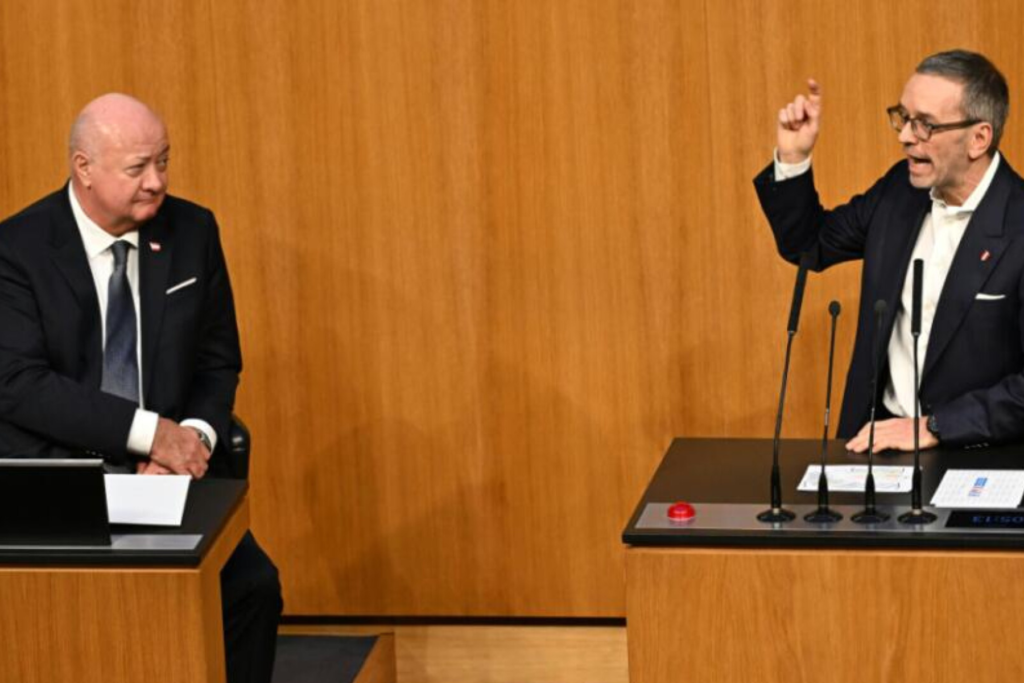
In a special session on Tuesday, the National Council debated the electricity tax cut announced by the federal government. The plan is to reduce the tax in the 2026 calendar year from the current 1.5 cents per kilowatt-hour (kWh) to 0.82 cents. For private households, the bill provides for a rate of 0.1 cents per kWh. The measure, introduced by the SPÖ, ÖVP, and NEOS, drew criticism from the Freedom Party (FPÖ) and support from the Greens.
FPÖ parliamentary leader Herbert Kickl described the scale of the electricity tax cut as a “sham package” presented by what he called the “loser traffic-light coalition” in a “pre-Christmas special session.” Chancellor Christian Stocker (ÖVP) was portraying himself as a “political Santa Claus,” Kickl said, blaming this “miraculous transformation” on plunging poll numbers for the governing parties. Once again, he argued, the public was being “misled,” as it had been a week earlier with the presentation of the so-called “cheap electricity law.” Even today’s relief, he said, was “a placebo rather than a breakthrough.” According to Kickl, the average household would save just four euros per month, limited to one year, before the measure expires in January of the following year. To fund this “generosity,” he added, the government was tapping dividends from Verbund, benefiting state-linked energy companies that had posted large profits.
Government parties praise relief
Lawmakers from the governing parties took a very different view. SPÖ finance spokesperson Kai Jan Krainer said the government had succeeded in curbing inflation in several areas, including rents, food prices, and now energy. The groundwork for this had been laid with last week’s “cheap electricity law,” he said, and the tax cut would now reduce electricity costs further. Krainer rejected criticism of the annual savings of around €50, or five percent. ÖVP MP Kurt Egger echoed this view, calling it “a small step, but a step.”
NEOS parliamentary leader Yannick Shetty said the government had taken concerns seriously that some previously adopted measures would take time to have an effect. The electricity tax cut was therefore an immediate response—one that the FPÖ itself had demanded the previous week, he noted.
Green MP Jakob Schwarz supported the measure, saying it would genuinely lower prices for households and businesses, noting that high electricity prices were a problem for consumers, industry, and climate policy.
Merit order principle under scrutiny
Ahead of the session, the government announced it would send a letter to the European Commission calling for an end to the merit order principle in the electricity market, under which fossil fuels still set prices. Chancellor Stocker said Austria would propose concrete reforms. Vice Chancellor Andreas Babler (SPÖ) called the system “absurd,” while Foreign Minister Beate Meinl-Reisinger (NEOS) said Austria would push for a fairer sharing of grid costs at EU level.
The tax cut is expected to cost around €500 million, funded by state-linked companies including Verbund, the federal real estate company BIG, and undistributed dividends from state holding ÖBAG. Business groups welcomed the move but called for additional measures, including extending electricity price compensation beyond 2026.
