
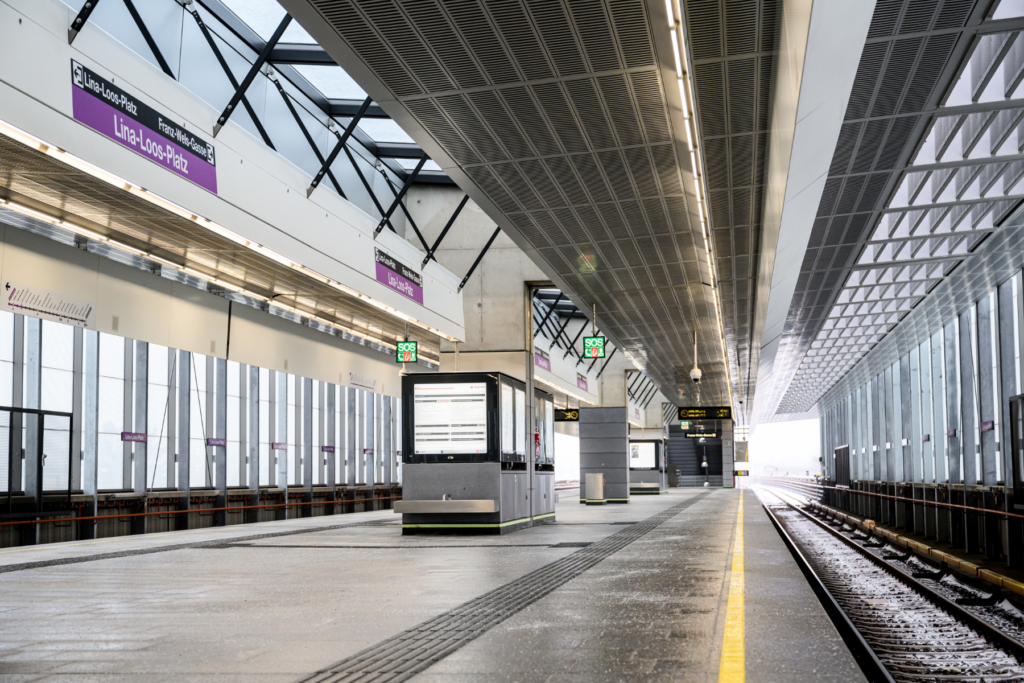
On Monday, January 19, 2026, the U2 subway station Lina-Loos-Platz in Vienna’s 22nd district will open for service. With the new stop, the U2 line will have 21 stations, and Vienna’s subway network will expand to a total of 110 stations. The new station is equipped with bicycle garages, green façades, and a photovoltaic system on the roof, further enhancing sustainability.
Connection to the Oberes Hausfeld Urban Development Area
Lina-Loos-Platz station is located between the U2 stations Aspernstraße and Hausfeldstraße and strengthens environmentally friendly access to Donaustadt and the Oberes Hausfeld urban development area, one of the largest growth zones in the 22nd district. A new urban neighborhood is being developed there across around 26 hectares, featuring 3,700 apartments, educational and recreational facilities, workplaces, and generous green spaces for approximately 8,000 future residents. With the opening of the Lina-Loos-Platz station, the new district will be connected to Vienna’s public transit network from the outset.
Station Expanded During Ongoing U2 Operations
The structural shell of the station was already built in 2013 as part of the extension of the U2 line to Seestadt Aspern. Further construction began in 2021 and was carried out while the U2 line remained in operation. This included the construction of stairways, a central island platform, two new elevators, and two bicycle garages. More than 70 photovoltaic modules installed on the station roof provide environmentally friendly energy. Green façades on both exterior sides of the station building improve the local microclimate.
The Namesake: Lina Loos (1882–1950)
The station and the adjacent Lina-Loos-Platz are named after actress and writer Lina Loos. She was married to renowned architect Adolf Loos from 1902 to 1905. After the marriage ended, Lina Loos took the then highly unconventional step of divorce and went on to build an international career as an actress and writer. She engaged deeply with the social and cultural life of Vienna in her time and is considered a pioneer of female emancipation. Lina Loos was active as a peace activist, a member of the Austrian Peace Council and the Federation of Democratic Women, and advocated throughout her life for peace, disarmament, opposition to neo-fascism, and women’s rights.
Women remain significantly underrepresented in Vienna’s place names. According to a 2023 analysis by the European Data Journalism Network, around 90 percent of street names are dedicated to men. Because subway stations are named after their surroundings, only two stations had previously been named after women: U4 Margaretengürtel (after the martyr Margaret of Antioch) and U6 Längenfeldgasse (after benefactor Josefine Haas von Längenfeld-Pfalzheim). The City of Vienna is actively addressing this imbalance, for example by naming all new streets in Seestadt Aspern after women. With the new U2 station and the adjacent square named after Lina Loos, another prominent Viennese woman is becoming visible in the cityscape.
Climate-Friendly Mobility and a Green Lina-Loos-Platz
Climate-friendly mobility was a central focus of the planning. Two new bicycle garages at the station entrances make it easy to switch between cycling and the U2. Bicycles can be parked there for up to 24 hours for €1.50. Wide, physically separated bike lanes will run along An den alten Schanzen and the subway corridor to Lina-Loos-Platz station. A WienMobil Rad bike-sharing station will also be integrated into the square. In the southwest of the plaza, directly next to the subway station, a new bus stop will be built, ensuring short transfer routes and improved comfort for public transit users.
In the coming years, the Lina-Loos-Platz adjacent to the station will be redesigned as a green urban oasis. Plans include more than 50 new trees, a water feature, extensive green areas, and seating. Around 1,800 square meters of green space will be created, along with approximately 2,300 square meters designed to allow rainwater to seep into the ground, supporting the natural water cycle and providing cooling through evaporation, particularly during the warmer months.
