
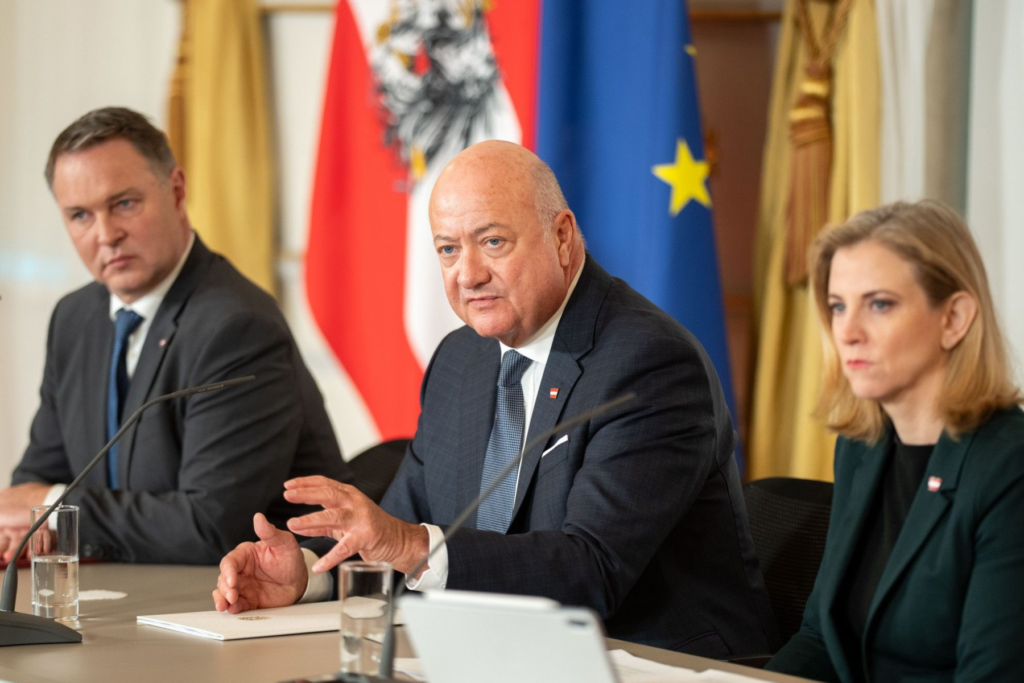
The coalition of ÖVP, SPÖ, and NEOS has been without a majority in the APA election trend since the fall. In their first year in government, the three coalition parties have lost significant public support. Since the fall, the coalition has no longer been able to achieve a majority in polls according to the APA election trend.
The SPÖ has recorded the largest losses since the swearing-in nearly a year ago, but compared with the national parliamentary election in the fall of 2024, the chancellor’s party, the ÖVP, has lost the most support. Only the opposition parties FPÖ and Die Grünen have made gains.
47.1 Instead of 51.5 Percent
At the start of the three-party coalition, which will mark its first anniversary next Tuesday, ÖVP, SPÖ, and NEOS together still held a narrow majority of 51.5 percent last year. A few weeks later, at the end of March, the coalition reached its highest polling result so far at 53.9 percent, according to the APA election trend, which takes into account polls from the past five weeks and weights them by recency. However, the combined 56.5 percent achieved in the September 2024 parliamentary election has never been reached again since taking office.
Just six months after the swearing-in, the three governing parties lost their majority support in polls. Since early September 2025, the APA election trend has consistently placed them below the 50 percent mark. According to current surveys, nearly one year after taking office, only 47.1 percent of votes would go to the coalition parties. The lowest level was recorded shortly before Christmas at 45.9 percent. Over the first year of the black-red-pink coalition, polling figures fluctuated within a range of eight percentage points.
Losses for Coalition Parties
All three coalition parties have struggled with declining popularity since the parliamentary election. The ÖVP lost more than a quarter of its supporters in polls between election day (26.3 percent) and the swearing-in (19.2 percent), temporarily falling to third place behind the FPÖ and SPÖ. The ÖVP has since recovered somewhat and now stands at 21.2 percent, again ahead of the Social Democrats. Nevertheless, under party leader and Federal Chancellor Christian Stocker, the People’s Party continues to record the largest loss among parliamentary parties compared with its election result, at around five percentage points.
The SPÖ, whose party leader Andreas Babler serves as vice chancellor, currently stands at 18 percent, clearly below its election result of 21.1 percent by 3.1 percentage points. Compared with the start of the government one year ago—when the SPÖ was still ahead of the chancellor’s party with support from 21.5 percent of respondents—the Social Democrats have recorded the largest decline among coalition partners, at 3.5 percentage points.
NEOS, the smallest coalition party, has also lost support. Under party leader and now Foreign Minister Beate Meinl-Reisinger, the party achieved its best-ever parliamentary election result in 2024 with 9.1 percent, placing fourth. Its first participation in the federal government boosted approval to 10.8 percent in March 2025. Since summer, however, a negative trend has emerged, and NEOS currently stands at 7.9 percent, its lowest polling level since 2020.
35.9 Percent for the FPÖ
The two opposition parties, FPÖ and the Greens, have benefited from the governing parties’ losses. The election winner FPÖ, led by party chief Herbert Kickl, has consistently polled above its record election result of 28.9 percent since the parliamentary election. In the current APA election trend, 35.9 percent support the Freedom Party, an increase of around one quarter. The party’s peak stood at 37.8 percent at the start of ultimately failed coalition negotiations with the ÖVP in mid-January 2025. Last December, the FPÖ alone recorded 37.7 percent support—more than the ÖVP and SPÖ combined, which together reached 36.6 percent. This ratio has since shifted again in favor of the two coalition partners, who now jointly stand at 39.2 percent.
The smallest of the five parliamentary parties has also gained somewhat since the election. After finishing fifth in 2024 with 8.2 percent, the Greens, under newly elected federal spokesperson Leonore Gewessler, overtook NEOS over the summer and currently poll at 9.4 percent. Meanwhile, the KPÖ has approached the four-percent threshold required for entry into the National Council. At 3.8 percent, the Communists currently exceed their election result by 1.4 percentage points.
Looking Back
That participation in government during times of crisis can negatively affect polling numbers is not a new phenomenon. The previous ÖVP-Greens coalition, for example, lost the majority of 51.4 percent it had won in the 2019 parliamentary election during the first winter of the COVID-19 pandemic in early February 2021—around one year after taking office in January 2020.
More than six months later, around the resignation of then-chancellor Sebastian Kurz in October 2021, support fell to 39 percent. This figure was significantly undershot by the coalition parties in the remaining three years of government. A few months before the parliamentary election, polls reached a low point of 28.6 percent in mid-May 2024.
