
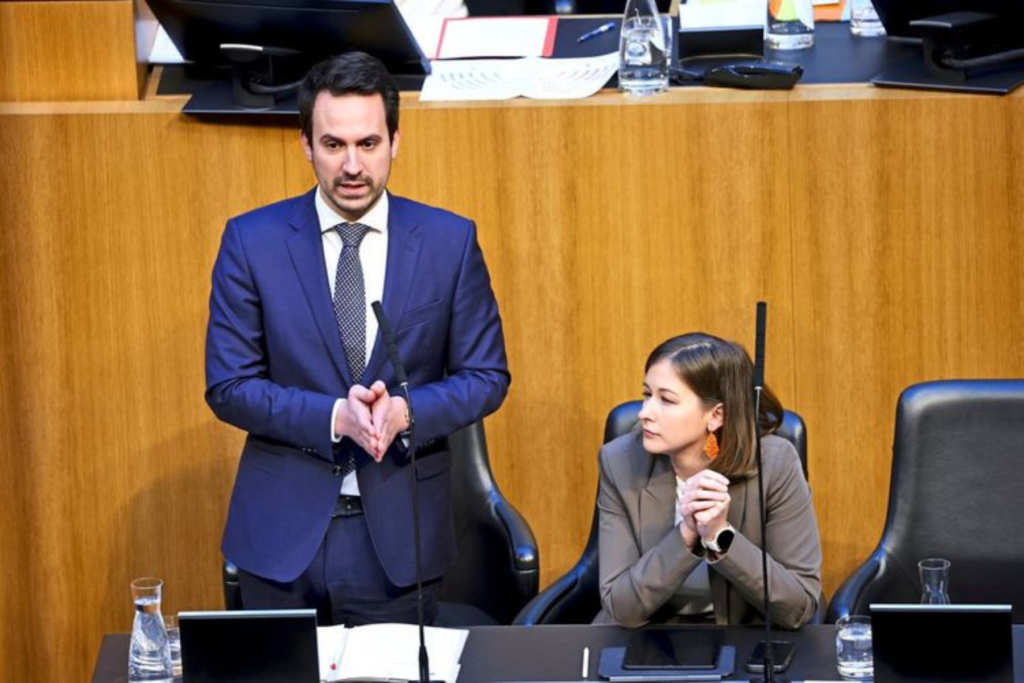
A majority in the National Council today approved an amendment to the School Act that legally anchors a headscarf ban in schools. To “protect age-appropriate development and freedom of self-expression,” female students up to their 14th birthday will be prohibited from wearing a headscarf in school that “covers the head according to Islamic traditions.” The provisions are to take effect on September 1, 2026, with an informational phase beginning in February. The amendment also introduces a support system for students who are suspended from class. Mandatory “perspective discussions” are intended to help prevent school dropouts.
Alongside the governing parties, the Freedom Party (FPÖ) also backed the bill, though it does not go far enough for them. During the debate, the FPÖ submitted a resolution calling for a headscarf ban and a ban on “veiling” in compulsory public schools for “all school staff, especially teachers.” The proposal failed to gain a majority.
The Greens did not support the amendment. While acknowledging the need for action, they argue that the proposed provisions are unconstitutional.
A majority also supported a resolution from the governing parties calling for clear standards and procedures for addressing challenging situations in schools. The aim is to ensure that the “opportunity bonus,” suspension support, perspective discussions, school psychology services, social work, and additional psychosocial support staff are deployed nationwide in a needs-based and transparent manner. The initiative was prompted by proposals from the Greens and FPÖ, which themselves did not pass. The Greens had pushed for expanded school social work and psychology services, while the FPÖ had submitted a “9-point plan for violence-free schools.”
Wiederkehr: Schools must be places of development
Education Minister Christoph Wiederkehr emphasized that schools must be safe spaces for students to develop freely. Conflicts in classrooms have increased, he said, as reflected in the rising number of suspensions. Suspension support is therefore a major personal priority for him. Students excluded for violent behavior should be supported and reintegrated into their classes. This represents a “paradigm shift” in dealing with violence in schools, Wiederkehr said. He also expressed confidence that the school headscarf ban for girls under 14 is constitutional, calling it a balancing of fundamental rights and emphasizing the need to enable girls to live self-determined lives. He pointed to accompanying measures such as boys’ work, psychosocial support, and child protection concepts.
Plakolm: Awareness phase begins in February
Integration and Family Minister Claudia Plakolm described the school headscarf ban as a “historic step for the protection of girls.” Young girls should grow up free from prescribed gender roles and not be taught that their bodies are something shameful that must be covered, she said. There will be “zero tolerance” for anyone who tries to hinder girls in their development. She announced that a research-based awareness campaign will begin in schools in February, and that authorities will intervene early in cases of pressure or threats. The “sanctions phase” will begin in September with the 2026/27 school year.
Under the draft law, a first violation requires school leadership to hold an immediate clarifying meeting with the student and her guardians. A second violation must be referred to the school authority, which must again schedule a meeting. A third violation requires notification of child and youth services. As a last resort, fines between €150 and €800 may be imposed, with substitute imprisonment of up to two weeks if unpaid.
FPÖ demands ban for teachers and staff
The government bill partially fulfills a long-standing FPÖ demand, said FPÖ MP Hermann Brückl. He claimed the ban is “not a restriction” but enables girls to “decide for themselves later.” He argued that the root of current problems lies in “failed mass immigration.” The bill is “half-hearted,” he said, because teachers and school staff may still wear headscarves. This is unacceptable, Brückl argued, because everyone in a school should be “neutral” and model core values. FPÖ MP Christoph Steiner questioned why the government did not adopt the law as a constitutional act and denounced the bill as “rushed and cosmetic.” The FPÖ again called for a ban on “political Islam,” arguing that oppression does not end at age 14.
Greens: Deploy rapid-response, multi-professional teams
Every girl has the right to a self-determined life, and there is “indeed a problem with children’s headscarves in schools,” said Green Party MP Sigrid Maurer. The idea of a ban is “absolutely correct,” but the current bill violates the constitution, she argued. Submitting an intentionally unconstitutional law is unacceptable, she said. Her party proposes the deployment of rapid, multi-professional teams—including cooperation with the Islamic Religious Community. Maurer also criticized changes to student representation rights, saying that reducing students’ involvement in exclusion procedures sends “a fatal and entirely wrong signal.”
Her colleague Barbara Neßler argued that boys’ work must also be addressed. A headscarf ban without meaningful support structures merely shifts the problem, she said.
ÖVP: Prioritize children’s rights
Balancing fundamental values is legally sensitive, said ÖVP MP Nico Marchetti. In the case of a headscarf ban, children’s rights must outweigh religious freedom, he said. The goal is to “send a symbol,” because extremism has no place in schools and children’s rights must be clearly prioritized. ÖVP MP Ernst Gödl said the debate is not about “a piece of fabric,” but about whether society accepts children wearing a symbol of female subordination. No theological expertise suggests a headscarf is required before puberty, he argued. ÖVP MP Agnes Totter highlighted the need for structured support and reintegration for suspended students, as well as stronger parental involvement.
SPÖ: Strengthen girls and expand work with boys
The child must be at the center, and no child should be exposed to coercion, said SPÖ MP Christian Oxonitsch. Teacher quality—not whether a teacher wears a headscarf—should guide educational practice. He said this amendment is not an “end point,” and there is much to do to strengthen girls and expand effective boys’ work. SPÖ MP Heinrich Himmer emphasized that suspension support and perspective discussions will help students stay on track for successful futures. SPÖ MP Petra Tanzler said many of the FPÖ’s proposed measures already exist or are being prepared.
NEOS: Girls decide over their own bodies
The headscarf ban in schools is not about limiting freedom but protecting it, said NEOS MP Yannick Shetty. “In Austria, it is not you who decides over girls’ bodies, but the girls themselves,” he said, addressing so-called moral enforcers. NEOS MP Martina von Künsberg Sarre stressed the importance of parental involvement in suspension support. NEOS MP Fiona Fiedler said early education on mental health is essential, as delayed intervention allows conflicts to escalate.
