
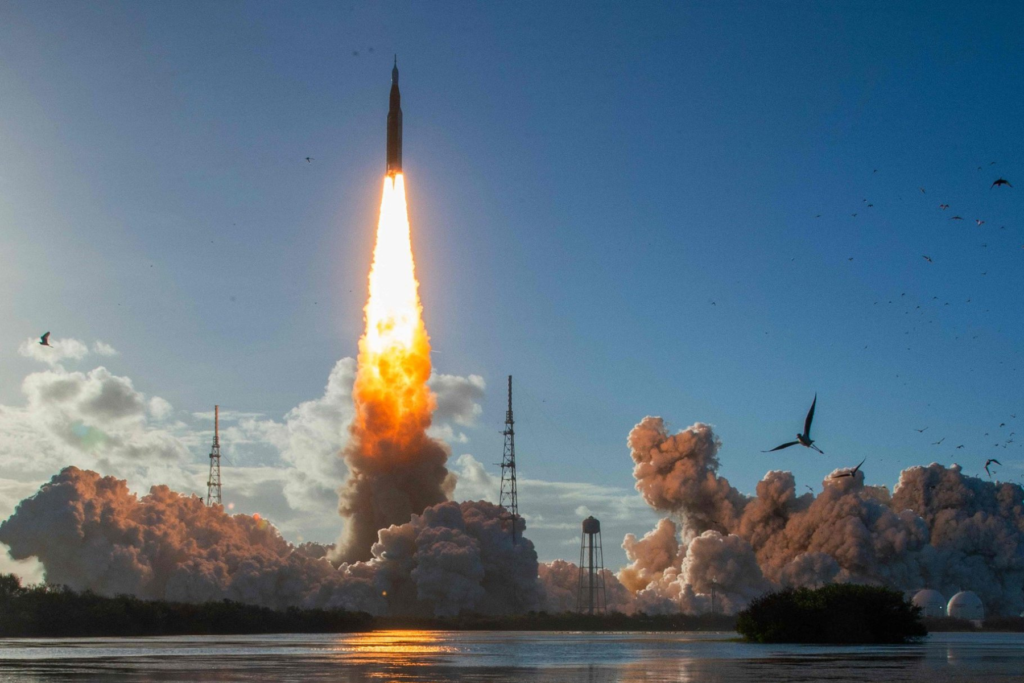
Technology from Austria is on board NASA’s “Artemis 2” moon mission. The Graz-based company Magna supplied high-pressure lines for the liquid tanks of the “Space Launch System” used to launch the “Orion” capsule of the “Artemis 2” moon mission. Attached to this capsule is the “European Service Module” (ESM), with technology from the Vienna-based high-tech company TTTech ensuring safety-critical data communication for all life-support and control systems.
ESA Responsible for European Service Module
The “Orion” capsule, which houses the astronauts during the mission, was built by Lockheed Martin. The flight control system is supplied by Honeywell Aerospace, a long-standing partner of TTTech. The European Space Agency (European Space Agency) was responsible for the ESM, which was built by Airbus in Bremen.
The service module contains the main engine used to propel the crew capsule toward the Moon. It regulates temperature and supplies power, and stores fuel as well as oxygen and water reserves for the four-member crew in the “Orion” capsule. At the end of the mission, the capsule and the ESM will separate shortly before arrival on Earth, with the service module burning up in the atmosphere.
ESA and TTTech “Proud” of Artemis 2
“Artemis 2 confirms Europe’s crucial role in humanity’s return to the Moon and in the future exploration of space. ESA is proud to stand side by side with its international partners under NASA’s leadership. Together, we demonstrate that cooperation remains our strongest driver for the future,” said ESA Director General Josef Aschbacher in an initial reaction.
As the “central nervous system” of the “Orion” capsule and the ESM, the “TTEthernet network” developed by TTTech connects numerous sensors, computers, and propulsion components (actuators). The overall system is responsible for various safety-critical functions such as flight control and life-support systems. According to the company, non-critical tasks such as video communication can also be handled via the network. TTTech said it is “incredibly proud” to contribute to the success of the mission, as Christian Fidi, head of the company’s aerospace division, stated in a press release.
“No Roadside Assistance in Space”
“In space, there is no roadside assistance, no maintenance options. Electronic systems must be designed and secured to function flawlessly for decades and withstand radiation in space,” Fidi explained, highlighting the importance of fail-safe data communication and robust electronics for such missions. Measurement systems from the Styrian company Dewetron are also involved in data acquisition and real-time monitoring of the mission. In addition, Johanneum Research in Graz has previously contributed technology and expertise to the Artemis program.
