
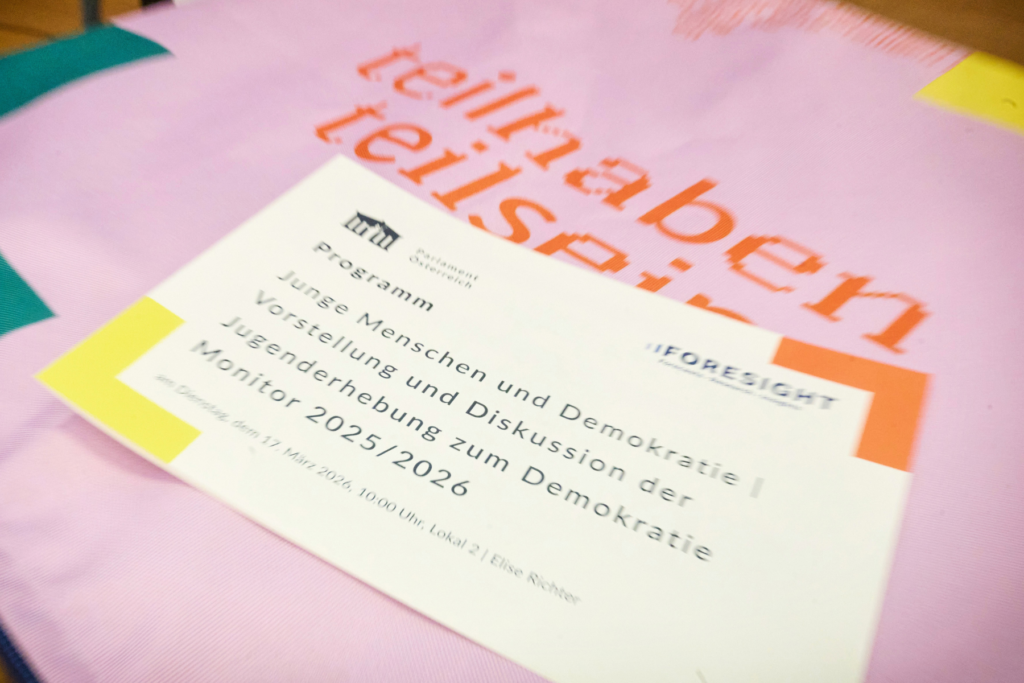
The crises of recent years have negatively affected young people’s trust in political institutions. Nothing changed last year, according to a survey conducted as part of the “Democracy Monitor” project by the social research institute Foresight. In the most recent survey, only 41 percent of 16- to 26-year-olds said they have a great deal or quite a lot of trust in Parliament. In 2020, the figure was still 56 percent. Over the same period, trust in the federal government fell from 51 percent to 37 percent. Only 44 percent now believe that Austria’s political system functions well. However, this critical view does not change young people’s overwhelming support for democracy: 89 percent of 16- to 26-year-olds still consider democracy the best form of government—the same share as at the project’s launch in 2018.
The study “Youth & Democracy 2025,” prepared by Martina Zandonella and Karoline Bohrn, was presented today in Parliament. Since 2018, Foresight has surveyed an additional 300 young people aged 16 to 26 each year for the Democracy Monitor. This year, the sample was significantly expanded and the questionnaire broadened. Around 1,000 adolescents and young adults took part in the telephone and online survey conducted in fall 2025. Representatives of the five parliamentary groups also discussed the findings, including the planned “social media ban” for those under 14.
Declining Trust Linked to Falling Sense of Representation
The findings largely confirm last year’s results. According to the authors, the decline in trust is closely linked to a diminishing perception of representation. While nearly two-thirds of young people in 2018 felt well represented in Parliament, only 32 percent have felt that way since 2021. Belief in being able to make a difference through political participation has also declined. Social and economic realities play a significant role: those with higher financial resources feel better represented and assess the system more positively than those from low-income households. The same applies to young people with a university degree compared to those without tertiary education.
Notably, 39 percent of young men, but only 27 percent of young women, feel very or fairly well represented in Parliament. Accordingly, 44 percent of young men trust Parliament, compared to 37 percent of young women.
When asked about political priorities, respondents most frequently cited the cost of living, affordable housing, and education, training, and employment. Young people expect more support in choosing education and careers and in transitioning into the labor market. Effective climate action, social equity, poverty reduction, and access to health care were also emphasized. Migration, security, democracy, and digitalization followed at some distance.
Interest in Politics and Parliament
The study does not support claims that young people are politically apathetic. On the contrary, political issues are more present in their daily lives than before 2020. Nearly all 16- to 26-year-olds discuss politics within their social circles and at least occasionally seek political information. Social media—especially Instagram—remains the most frequently used source.
More than half of respondents would like to know more about which bills are currently being debated and how they can participate. Around half also want more information on how laws are made. Despite growing distance from the political system, their willingness to learn about democracy and engage in decision-making processes remains strong, the authors note.
Compared with older people, young people still have a slightly more positive view of Austria’s political system: among those over 27, only 33 percent believe it functions well.
Lawmakers Discuss Findings
In a panel discussion, FPÖ youth spokesperson Sebastian Schwaighofer said the findings did not surprise him, citing global political changes. He emphasized that young people should be vocal and engaged and called on governing parties to act.
Green MP Barbara Neßler encouraged young people to address their concerns directly to politicians, noting that social media has made contact easier. She cited the free HPV vaccination for young people as an example of successful advocacy.
Four parties expressed support for age restrictions on social media. Neßler argued that if alcohol and cigarettes are restricted, social media should not be ignored. ÖVP MP Carina Reiter, SPÖ MP Paul Stich, and NEOS MP Johannes Gasser also supported age limits, stressing child protection and mental health concerns. Gasser and Neßler also highlighted the need to strengthen media literacy, including identifying AI-generated content.
FPÖ MP Schwaighofer opposed a “social media ban,” arguing that social media is part of young people’s everyday reality and that they can distinguish right from wrong.
Addressing the “Representation Gap”
NEOS MP Gasser noted that young people often must prove themselves more to be taken seriously. SPÖ MP Stich said trust would rise quickly if politics improved young people’s living conditions. Both Gasser and Stich also pointed out that many young people living in Austria are not eligible to vote, which can hinder engagement.
Parliament Director Harald Dossi emphasized that the Democracy Monitor is a key source of information on public attitudes. Austria remains one of the few countries where voting is permitted at age 16, he noted, underscoring Parliament’s responsibility to prepare young people for participation through civic education initiatives.
