
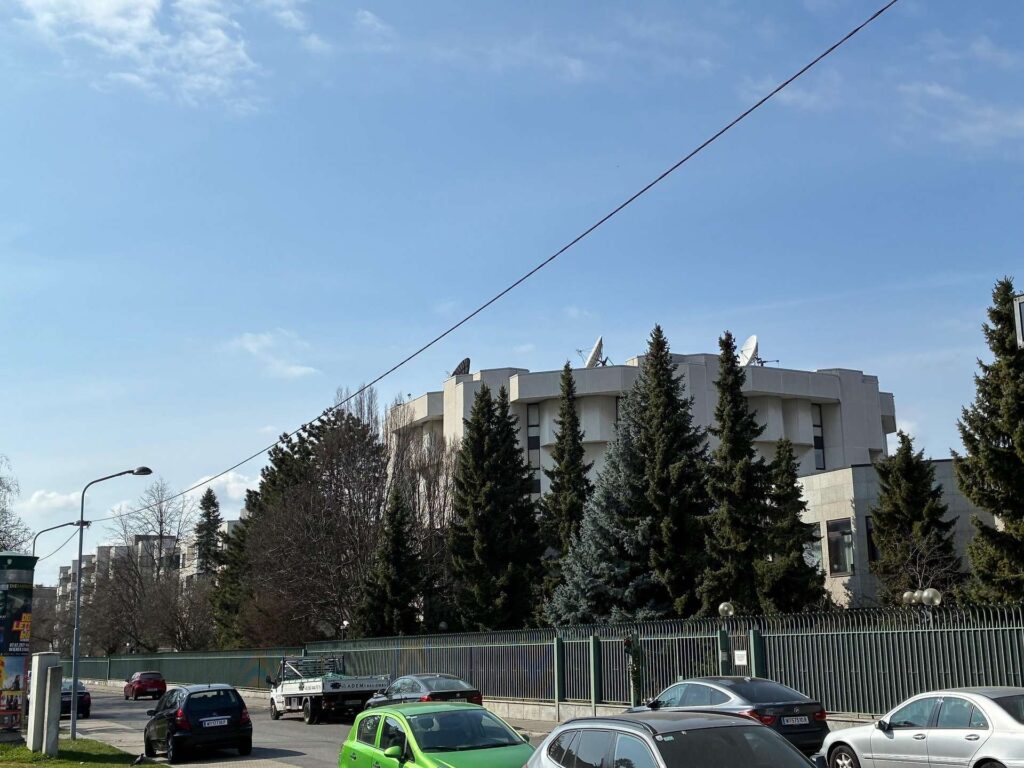
According to the Financial Times, rooftop satellite dishes atop Russia’s diplomatic sites in Vienna are drawing growing scrutiny from Western security officials who suspect the equipment is being used for covert signals intelligence rather than routine embassy communications.
The cluster of dishes — visible from upper floors near the golden domes of Vienna’s Russian Orthodox cathedral — stands out, the report notes, because several are not oriented toward Russia. A senior European diplomat based in Vienna told the Financial Times that Russian operatives have targeted NATO government and military communications using capabilities based in the Austrian capital, describing Vienna as a key hub for Moscow’s intelligence activity in Europe.
Western officials and experts cited by the Financial Times said the Vienna platform is believed to monitor satellite and electronic communications not only across Europe, but also across parts of the Middle East and Africa. The attention comes as Russia’s intelligence footprint has been squeezed elsewhere: after the full-scale invasion of Ukraine in 2022, many European countries expelled Russian diplomats. Neutral Austria, however, took a more permissive approach to Moscow’s outposts.
Austria’s own domestic intelligence service has also raised alarms. The DSN recently warned that the “technical capabilities and adaptable alignment” of Russian SIGINT stations in Vienna represent a significant counter-espionage risk, according to the Financial Times.
A Western intelligence official in Vienna told the Financial Times that several new dishes and other unusual rooftop installations have appeared over the past two years. The official highlighted how frequently some dishes are repositioned — a pattern that, in their view, suggests active targeting of multiple satellites. Embassy communications links back to Moscow would not require constant re-aiming, the official said.
The Financial Times also reported a striking example: on the eve of last month’s Munich Security Conference, one of the largest rooftop dishes was reoriented and then returned to its prior position the day after the conference ended — a shift officials say can provide clues about Russian collection priorities.
Open-source analysts have tried to map those priorities using imagery
The Financial Times described hundreds of high-resolution photographs taken over the past two years by NomenNescio, a Vienna-based group of electronic engineers and communications enthusiasts documenting equipment on the roof of a large Russian compound they jokingly call “Russencity.”
Russencity, the Financial Times reported, sits on the east bank of the Danube on a nine-acre site behind high-security fencing, with residential buildings and a school for diplomats’ children. At its center is a six-story octagonal building housing Russia’s mission to the United Nations, topped by a roof crowded with dishes.
Erich Moechel, a spokesperson for NomenNescio, told the Financial Times the group uses rooftop and aerial images to infer which satellites the dishes are trained on at different times. He said many point west toward geostationary satellites between the prime meridian and 15 degrees east. Based on visible receiver components and the frequencies involved, the group identified four satellites — Eutelsat 3B and 10B, and SES-5 and Rascom QAF1 — which provide communications links between Africa and Europe, according to the report. Moechel also said images suggest modifications that could broaden the range of signals collected compared with standard equipment.
Vienna’s geography may help explain the interest
Moechel told the Financial Times the city is “optimally positioned,” noting that one of Europe’s major satellite communications stations lies a little more than 100 kilometers southeast, while Vienna hosts international organizations with their own satellite infrastructure — including UN agencies, the OSCE, the IAEA, and OPEC.
The compound’s origins also fuel suspicion. Thomas Riegler, an Austrian historian specializing in espionage, told the Financial Times that Russencity, which began construction in 1983, was likely designed with signals intelligence in mind. He said the project was ordered by Yuri Andropov, the longtime KGB chief who briefly led the Soviet Union, and designed as a strategic statement about Vienna’s importance.
The Financial Times reported that Austria’s intelligence assessments still place roughly 500 Russian diplomatic staff in Vienna, with as many as a third believed to be covertly operating as spies. Russencity is described as only one node in a broader network: the Financial Times cited rooftop equipment at Russia’s embassy near the cathedral and at the Russian cultural center at Brahmsplatz. It also pointed to dishes on a former sanatorium on Sternwartestrasse acquired by Russia in 1953, and to another Danube-side property showing signs of renewed activity — including added security, a daily bus, and a small rooftop hut visible in satellite imagery. Such huts, Moechel said, are used to conceal sensitive equipment using low-density material, similar to coverings seen at U.S. and British embassy sites.
Vienna is not unique as a collection point
Riegler told the Financial Times that major intelligence powers collect signals intelligence in the Austrian capital, but argued Russia does so more openly and sometimes crudely — a posture he linked to confidence.
The constraint, the report adds, is legal and political. Under Austrian law, espionage is generally prosecutable only when directed against Austria’s national interests, limiting counterintelligence tools. Despite DSN warnings and recommendations, Vienna has shown little appetite for expulsions or other measures that could provoke retaliation, officials told the Financial Times. The Austrian interior ministry declined to comment beyond the DSN’s latest report, the newspaper said, and the Russian embassy in Vienna did not respond to a request for comment.
Austria is neutral and not a NATO member, but has sought to rebuild security ties with European partners in recent years, the Financial Times wrote — alongside a quiet acknowledgment that Russia is a shared threat. One Austrian security official told the newspaper that, even if expulsions are unlikely, Austria can still help deter and disrupt hostile activity through other means, including information-sharing. In intelligence work, the official added, it can sometimes be preferable to watch rather than act.
